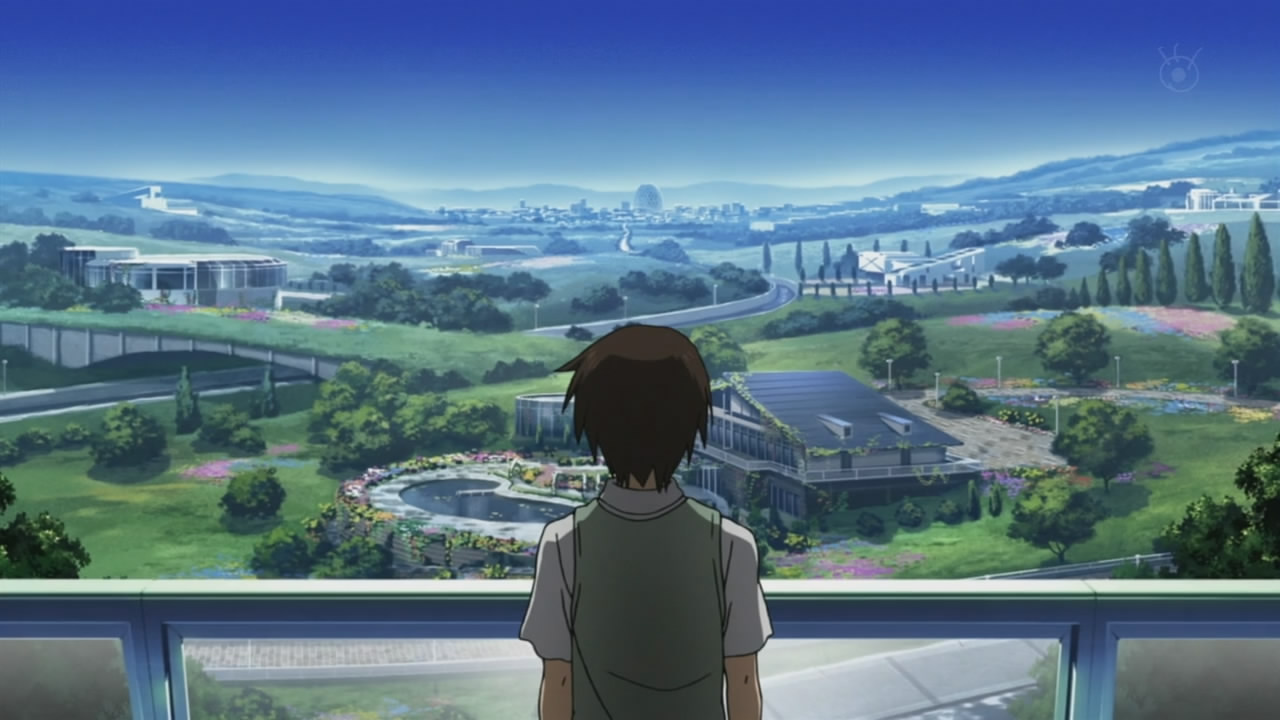
I can't help but notice that people seem to have somehow gotten the impression that I hate everything. Ha ha, I know, right? Now, far be it from me to speculate how such disheartening and blatantly ridiculous rumors got their start, but I do know one thing: the jokes about it are starting to get groan-worthy and need to be put to a halt for the good of all. Oh, certainly, I tend to pay attention to the shortcomings of even stuff I like, and I don't give out perfect ratings lightly, but the truth is that my high standards are precisely what gives me a keen appreciation for genuine quality. I am perfectly willing to give praise where praise is due, and there are anime that make me geek out with adoration. Clearly, I didn't gush enough in my review of Spice and Wolf...
So, because this blog could use some content – and because I'm an enormous narcissist – I'm going to count down my the five anime episodes I like the most in pictures, one post at a time.
Guilty Crown, frankly, makes me mad. It makes me mad because I can already tell how much crap it's going to get away with simply because it's not bad, because it doesn't even really have to try, because let's all just settle for less! A man can get cynical sometimes...
The series takes place in a near-future Japan that has been conquered by foreign powers. There are mechas in it, as well as a girl in a wheelchair. The main character, Shu Ouma, is a high-school student that becomes embroiled in a resistance movement when he receives a super-power from a mysterious girl wanted by the authorities.
Incidentally, it's written by the same writing team that gave us Code Geass. Comparisons to it are not only unavoidable considering how unbelievably similar the premises are, but they're also helpful, since they serve to warn unsuspecting viewers that they're watching a show that may catastrophically jump the shark at any moment. (And frankly, I don't think the writers should be let off from being called out on their hideous lack of imagination.)
So how was the first episode?
It was decent. Exciting enough. Quite stylish. Technically impressive, I suppose.
Once you start going into the details, things get problematic.
I don't expect characters to show a lot of character right in the first episode, where most anime are more concerned with wowing the viewers and setting up the plot. Still, I find myself a little annoyed with Shu, who is already far less charismatic and far more generic than Code Geass's Lelouche. He leaves an impression with exactly two things: extremely non-specific angst – I dare anyone to explain to me what the hell his problem is supposed to be – and completely ridiculous responsibility issues. Here's how Guilty Crown establishes someone to be a wuss: they didn't fight a crowd of armed soldiers bare-handed to save a damsel in distress. Yes, that's it. This is the guilt the protagonist has to be put up with! Boo fucking hoo? I do hope the point I'm trying to make isn't getting lost because of my sarcasm, but this really is a silly and unrelatable issue to set as your protagonist's driving motive.
It's the female lead that's the real sticking point to me though. I have to admit, I feel a measure of resentment for her solely because of how desperate the show seems to be to make me like her. We find out little about her personality except that she's a little strange and likes to sing, but we're treated to scenes of her wounded, on the run, captured, treated horribly, all the while the direction is trying its best to make her striking and not being very subtle about it. This is shallow. It's lazy. Relying on the viewer's protective instinct is such a simplistic way to elicit sympathy from them, and I don't know who to blame for wondering whether there's something wrong with me for having a problem with the fact that a professional writer can't do better.
And might I just ask – what is up with her ridiculous outfit? Am I really the only person watching this who wondered why in the seven hells this girl entrusted with some kind of secret mission was running around with clothes that expose two thirds of her torso, sleeves so big she couldn't even sit down at the dinner table with them and some kind of bizarre shawl that seems to be attached to her by magic? How is she supposed to blend in like that? Is that why she was on the run in the beginning? Someone saw her and went “Hey look, that girl who looks like she just escaped from the hooker circus must have stolen our super weapon!” It's ridiculous.
“But Kaarel,” you might say, “Isn't that nitpicking? Aren't you being just a little harsh?”
Well, someone has to be, gods damn it! Someone has to be! ;_;
There are three kinds of entertainment: the kind that requires you to think to enjoy it, the kind that doesn't require you to think to enjoy it, and the kind that requires you NOT to think to enjoy it. I'm not a fan of that last one. I've long since given up on expecting practical outfits for female characters, but are semi-quasi-pseudo-practical outfits really too much to hope for as well? Is a story that holds up under scrutiny really such a high demand?
One last thing... Perhaps I'm jumping the gun here, but I sensed a vague nationalistic undercurrent in the writing. Japan is known to be a little xenophobic, and Code Geass had its share of awkward subtext. Tell me it isn't a little uncomfortable that Guilty Crown's premise seems to be foreign nations dominating Japan because of sinister international aid during a crisis? The series also has two lone colored characters, one of whom happens to be an underling of the fascist regime who orders a massacre and the other a thuggish mugger. It's probably a coincidence, but come on, doesn't it make you raise an eyebrow? Just a little bit? No? Really? Well, maybe it's just me.
So should you give Guilty Crown a shot? Eh, sure, why not? It looks like it'll be entertaining. You could do a whole lot worse.
Next up, we'll take a look at summer's pair of noitaminA anime.
No. 6
No. 6 is based on a series of science fiction novels by Atsuko Asano that concluded only last month. It seems like a natural successor to a previous noitaminA series, this winter's Fractale, and I find this more than questionable considering the fact that Fractale tanked badly in both ratings and sales.
No. 6 is a city, a post-apocalyptic utopia that houses one of the last remaining pockets of humanity. Our protagonist, Shion, is a prodigy studying in an elite school. One day, during a stormy night, a wounded boy stumbles into his room. Nezumi is rather threatening and seems to have escaped from a correctional facility, but he and Shion seem to hit it off nevertheless. Nezumi hints that there might be something sinister about No. 6 – as if the mention of a "Ministry of Peace" wasn't enough to tip off the viewer – and disappears by the morning.
Most of the episode deals with building the rather suggestive relationship between the two male leads. I'm dead serious here; the homoerotic undertones are hard to overlook. Shion starts off the episode acting completely disinterested in a kiss by his "unlucky childhood friend" character and ends it falling asleep while holding Nezumi's hand. The presentation is tasteful enough, but it remains to be seen whether this will be used as a carrot to keep the female audience watching or whether something will actually come of it. I couldn't help but be amused when the English subtitles had them calling each other "hot" (in the literal sense of the word). Nezumi's character, the mysterious agent interrupting an ordinary protagonist's daily life, would probably be female in most other anime. Indeed, this character was female in Fractale.
The characters come across as relatively down-to-earth and believable. Shion seems rather bland in his eccentricity and vague cheeriness, and I found his not-girlfriend rather tedious as well, though largely because I fear she's going to be utterly pointless. Nezumi seems more compelling. The animation looks great, as to be expected from Studio Bones. There are some great, detailed backgrounds to be found. The major problem with the episode is that very little happens throughout it. Considering that it's an 11-episode series, that's a bit of an issue. There seems to be a time skip ahead, so perhaps this episode can be discounted as a prologue, but I still found it more boring than it should have been. It's going to take a few more episodes for me to make up my mind about No. 6, but as of right now, I'd say it's skippable.
Bunny Drop
Bunny Drop is adapted from a manga. The basic story is that Daikichi Kawachi, a thirty-year old bachelor, returns home for his grandfather's funeral and discovers that the old man had had an illegitimate child. The six-year old girl, Rin, is regarded as shameful and unwanted by the rest of the family, so Daikichi decides to take care of his young aunt himself. What follows is a heartwarming tale of parenthood and growing up...
I haven't read the manga, but I do know about its infamously ruinous ending. I'm not doing to spoil anything, but you know what? I bet you can guess exactly what that ending is based on the plot description. Yeeeesss, you suspect, don't you? Because there's pretty much only one way a story like this can go catatrophically wrong, isn't there?
Bunny Drop's troubles started after a time skip, however, and it's very probable that the anime will only cover the material leading up to it. If the series ever gets a second season though, be very, very worried – there's always the chance the producers will decide to scrap the original crap ending and create their own, but if not, this series is screwed.
The first episode's mood is melancholy and sweet, and its story mature and subtly told. It's a delight to see Daikichi's and Rin's relationship developing from their meeting. The show's art style is quite pretty – the style of the cold open is a little reminiscent of the water color-style of noitaminA's other winter 2011 entry, Wandering Son, the anime nobody watched (including me).
Rin is cutesy, but not an overly caricatured moeblob either, thank the gods. If there's a problem with her, it's that she's a little too gracious, a little too intelligent, a little too mature. This is further emphasized by her contrast with Reina, a completely insufferable child in the family. It feels kind of like cheating to make sure the viewer's sympathy is definitely invested in Rin, but I suppose I should be thankful it's not the other girl Daikichi has to take care of. Not much is established about Daikichi himself; he remains limited to his interactions with Rin.
Overall, if you like slow, atmospheric, heart-warming anime, you should probably give Bunny Drop a try – and hope for the best in regards to the future.